
Database Schema
The database schema of the process engine consists of multiple tables. The table names all start with ACT. The second part is a two-character identification of the use case of the table. This use case will also roughly match the service API.
ACT_RE_*:REstands for repository. Tables with this prefix contain ‘static’ information such as process definitions and process resources (images, rules, etc.).ACT_RU_*:RUstands for runtime. These are the runtime tables that contain the runtime data of process instances, user tasks, variables, jobs, etc. The engine only stores the runtime data during process instance execution and removes the records when a process instance ends. This keeps the runtime tables small and fast.ACT_ID_*:IDstands for identity. These tables contain identity information such as users, groups, etc.ACT_HI_*:HIstands for history. These are the tables that contain historical data such as past process instances, variables, tasks, etc.ACT_GE_*: General data, which is used in various use cases.
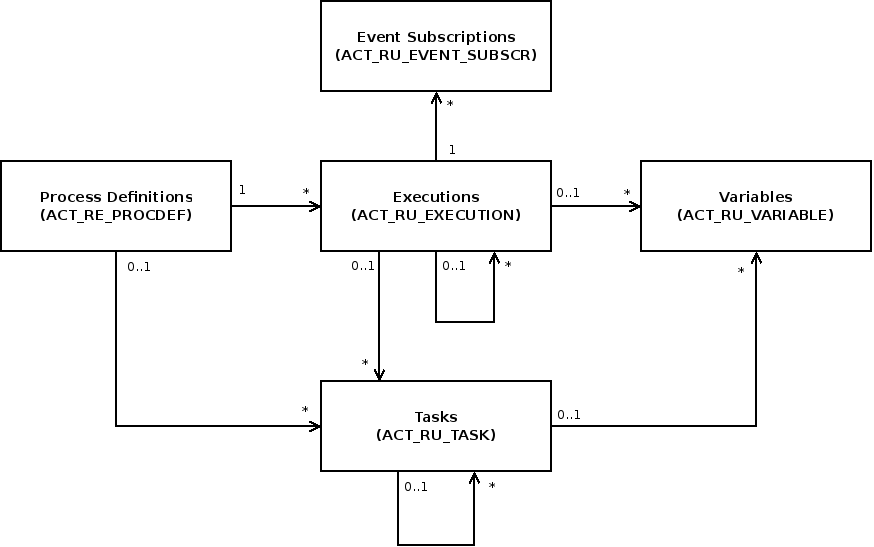
The main tables of the process engines are the entities of process definitions, executions, tasks, variables and event subscriptions. Their relationship is shown in the following UML model.
Process Definitions (ACT_RE_PROCDEF)
The ACT_RE_PROCDEF table contains all deployed process definitions. It
includes information like the version details, the resource name or the
suspension state.
Executions (ACT_RU_EXECUTION)
The ACT_RU_EXECUTION table contains all current executions. It includes
information like the process definition, parent execution, business key, the
current activity and different metadata about the state of the execution.
Tasks (ACT_RU_TASK)
The ACT_RU_TASK table contains all open tasks of all running process
instances. It includes information like the corresponding process instance,
execution and also metadata such as creation time, assignee or due date.
The table is indexed on PARENT_TASK_ID_ (ACT_IDX_TASK_PARENT_TASK_ID), because
completing or deleting any task looks up its subtasks by that column. SQL Server
has had the index since Camunda 7.21. The other databases get it in 1.4.4-ee:
an existing schema gets it from the patch script
$DATABASENAME_engine_1.4_patch_1.4.3_to_1.4.4.sql or the Liquibase changelog.
On SQL Server the patch script only writes the schema log. On PostgreSQL and
Oracle, creating the index blocks writes to ACT_RU_TASK until it is built,
which takes longer the more open tasks there are, so apply the patch when task
traffic is low.
Variables (ACT_RU_VARIABLE)
The ACT_RU_VARIABLE table contains all currently set process or task
variables. It includes the names, types and values of the variables and
information about the corresponding process instance or task.
Event Subscriptions (ACT_RU_EVENT_SUBSCR)
The ACT_RU_EVENT_SUBSCR table contains all currently existing event
subscriptions. It includes the type, name and configuration of the expected
event along with information about the corresponding process instance and
execution.
Schema Log (ACT_GE_SCHEMA_LOG)
The ACT_GE_SCHEMA_LOG table contains a history of the database
schema version. New entries to the table are written when changes to
the database schema are made. On database creation the initial entry
is added. Every update script adds a new entry containing an id,
the version the database was updated to and the date and time
(timestamp) of the update.
To retrieve entries from the schema log, the SchemaLogQuery-API can be used:
List<SchemaLogEntry> entries = managementService.createSchemaLogQuery().list();
Metrics Log (ACT_RU_METER_LOG)
The ACT_RU_METER_LOG table contains a collection of runtime metrics that can help draw conclusions about usage, load
and performance of EximeeBPMS. Metrics are reported as numbers in the Java long range and count the occurrence of
specific events. Please find detailed information about how metrics are collected in the Metrics User Guide.
The default configuration of the MetricsReporter will create one row per metric in ACT_RU_METER_LOG every 15 minutes.
Task Metrics Log (ACT_RU_TASK_METER_LOG)
The ACT_RU_TASK_METER_LOG table contains a collection of task related metrics that can help draw conclusions about usage, load
and performance of the BPM platform. Task metrics contain a pseudonymized and fixed-length value of task assignees and their time of appearance. Please find detailed information about how task metrics are collected in the Metrics User Guide.
Every assignment of a task to an assignee will create one row in ACT_RU_TASK_METER_LOG.
Business Event Outbox (ACT_RU_BUS_EVT_OBX) — Enterprise Edition
The ACT_RU_BUS_EVT_OBX table backs Business Events (Enterprise Edition), available since EximeeBPMS 1.2.16-ee. It implements the transactional outbox pattern: a row is inserted in the same transaction as the business change it describes, and a background dispatcher later reads undelivered rows and hands them to the configured publisher. The table is generic across all business event types — adding a new event type (e.g. the job, batch, incident, external task, activity instance, DMN decision, form property, and user operation log events added in 1.3.1-ee) does not require a schema change, since the event payload itself is stored as an opaque JSON string.
| Column | Type | Description |
|---|---|---|
ID_ | bigint | Primary key, auto-generated. |
CREATED_DATE_ | timestamp | When the row was written — i.e. when the underlying business change committed, not when it was dispatched. |
BUSINESS_EVENT_ | clob | The business event's payload, serialized to JSON. See the Business Event Field Reference for the fields behind each event type. |
EVENT_TYPE_ | varchar(255) | The fully-qualified event type, e.g. bpms:task-instance:complete — matches businessEventType inside the payload. |
PROC_INST_ID_ | varchar(64) | Process instance id, when the event has a process context; otherwise NULL. |
ROOT_PROC_INST_ID_ | varchar(64) | Root process instance id (top of the call-activity chain), when applicable. |
PROC_DEF_KEY_ | varchar(255) | Process definition key, when the event has a process context. |
TASK_ID_ | varchar(64) | Task id, when the event is scoped to a task. |
PROCESSED_ | boolean | Whether the dispatcher has successfully delivered this row to the configured publisher. Defaults to false. |
PROCESSED_DATE_ | timestamp | When the row was marked delivered; NULL until then. |
There is no foreign key relationship from ACT_RU_BUS_EVT_OBX to the core runtime tables — by design, the outbox must survive the deletion of the process instance or task it describes. Delivered rows are removed automatically past their retention period; see Business Events — Configuration.
The table is indexed on PROC_INST_ID_ and TASK_ID_, so deleting a process instance’s or a standalone task’s events does not scan it, and on its undelivered rows (ACT_IDX_BEO_UNPROCESSED), which the dispatcher reads in ID_ order. The TASK_ID_ index was added in 1.4.2-ee; an existing schema gets it from the patch script $DATABASENAME_engine_1.4_patch_1.4.1_to_1.4.2_1.sql, which Liquibase skips when the table does not exist.
Script Violation Log (ACT_RU_SCRIPT_VIOLATION)
The ACT_RU_SCRIPT_VIOLATION table stores violation events recorded by Script Guard. A row is inserted each time a script triggers a security rule while Script Guard is in ENFORCE or AUDIT mode. This table is available from EximeeBPMS 1.3.0.
| Column | Type | Description |
|---|---|---|
ID_ | varchar(64) | Primary key. |
TIMESTAMP_ | timestamp | Time at which the violation was detected. |
PROC_DEF_KEY_ | varchar(255) | Key of the process definition containing the offending script. |
ACTIVITY_ID_ | varchar(255) | ID of the BPMN element (e.g., Script Task) that triggered the violation. |
LANGUAGE_ | varchar(64) | Scripting language (e.g., groovy, javascript). |
SOURCE_TYPE_ | varchar(64) | Origin of the script source: INLINE_SOURCE, DYNAMIC_SOURCE, RESOURCE, DYNAMIC_RESOURCE, EXPRESSION, or UNKNOWN. |
ORIGIN_ | varchar(64) | Who submitted the script: USER, PROCESS_APPLICATION, PLATFORM, or UNKNOWN. |
RULE_CODE_ | varchar(255) | Machine-readable rule code that matched (e.g., SCRIPT_SECURITY_RUNTIME_EXEC). |
REASON_ | varchar(1000) | Human-readable explanation of why the script was flagged. |
Older records can be purged automatically by setting retention-days in the Script Guard configuration.
The table is indexed on TIMESTAMP_, so that cleanup finds expired rows without scanning it. The index was added in 1.4.2-ee; an existing schema gets it from the patch script $DATABASENAME_engine_1.4_patch_1.4.1_to_1.4.2_2.sql, which Liquibase skips when the table does not exist.
When you apply the patch scripts by hand, skip one whose table does not exist: the engine creates ACT_RU_BUS_EVT_OBX only with business events enabled and ACT_RU_SCRIPT_VIOLATION only when Script Guard is not DISABLED, each with its index. On MySQL and MariaDB, _2 also changes ACT_RU_SCRIPT_VIOLATION.TIMESTAMP_ from timestamp(3) to datetime(3). This rewrites the table, blocking violation writes while it runs, and stores each value in the session time zone, so run it with the time zone the engine’s connections use.
The patch script $DATABASENAME_engine_1.4_patch_1.4.3_to_1.4.4_2.sql belongs to the change that stores dates in UTC (Database Time Zone: Migrating Dates to UTC). On MySQL and MariaDB it changes six history columns from timestamp to datetime: ACT_HI_IDENTITYLINK.TIMESTAMP_, ACT_HI_OP_LOG.TIMESTAMP_, ACT_HI_INCIDENT.CREATE_TIME_ and END_TIME_, ACT_HI_EXT_TASK_LOG.TIMESTAMP_ and ACT_HI_ADHOC_TURN.TIMESTAMP_. A timestamp column is read and written in the session time zone and rejects the UTC hour that does not exist locally at the start of daylight saving time. The change rewrites those tables, blocking history writes while it runs, so run it with the time zone the engine’s connections use. On the other databases the script only records the schema version. Liquibase skips it when the history tables do not exist.
Entity Relationship Diagrams
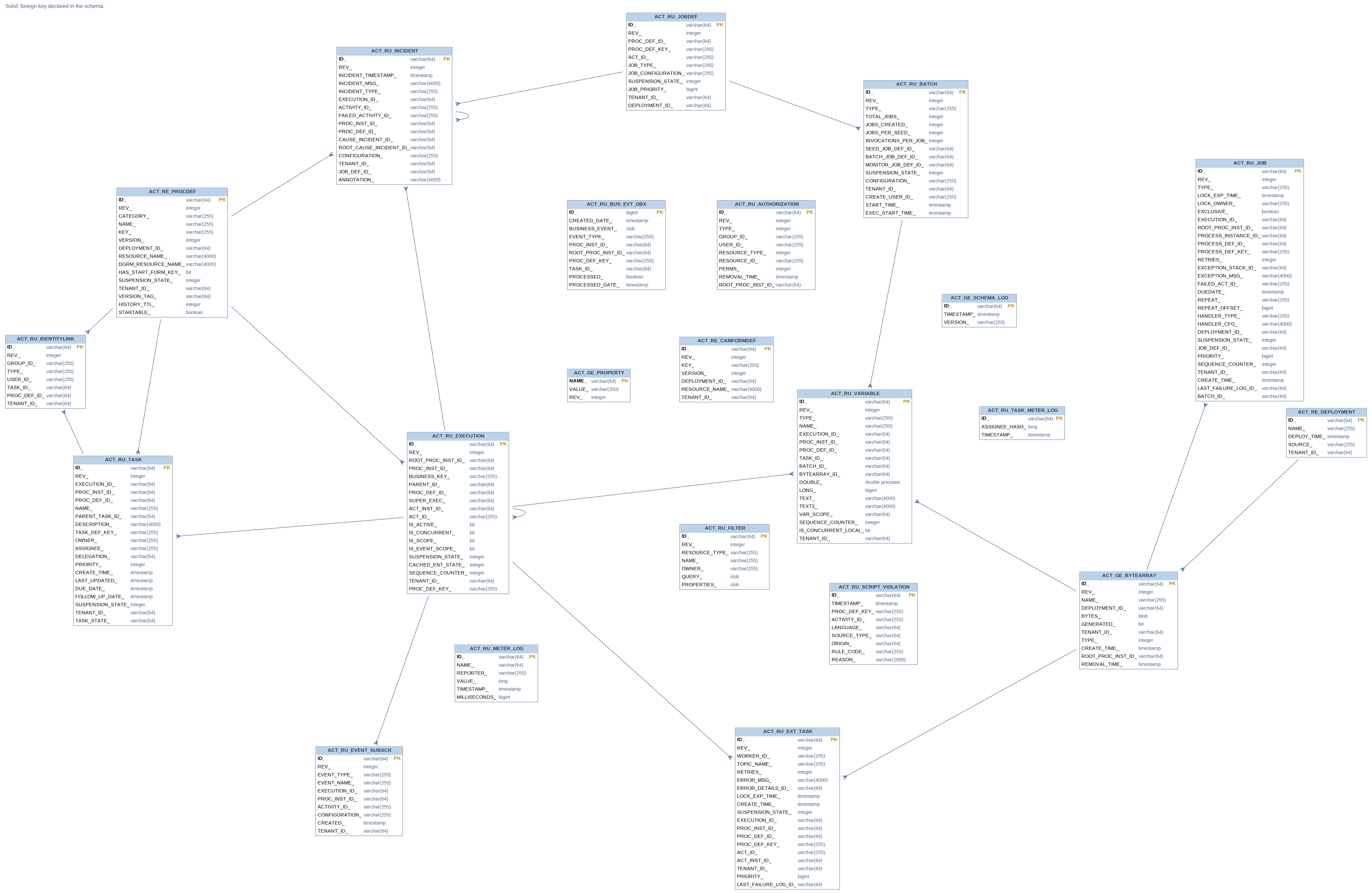
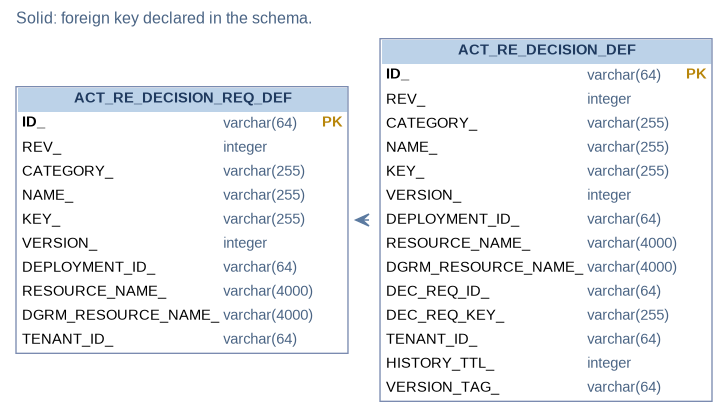
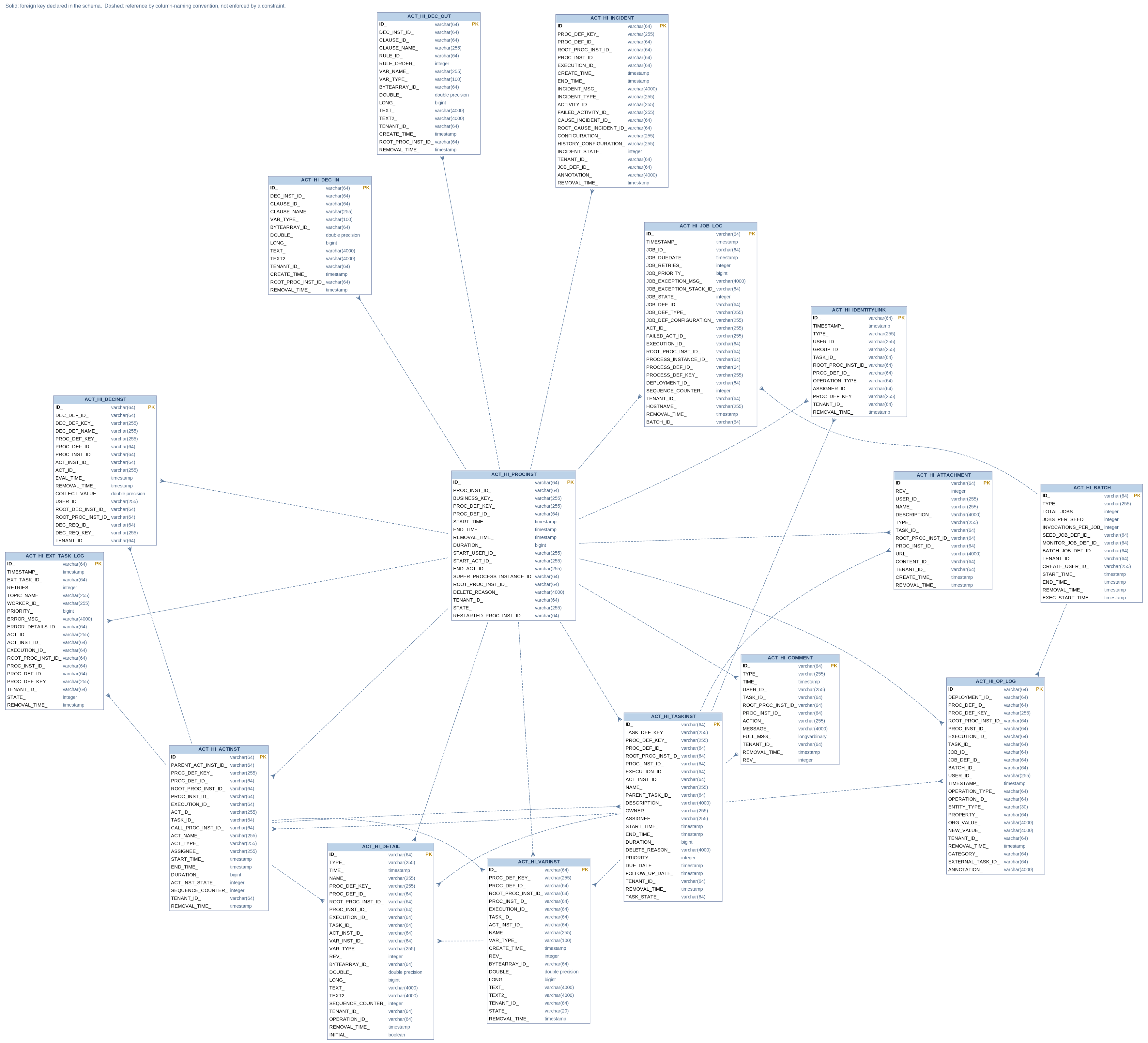
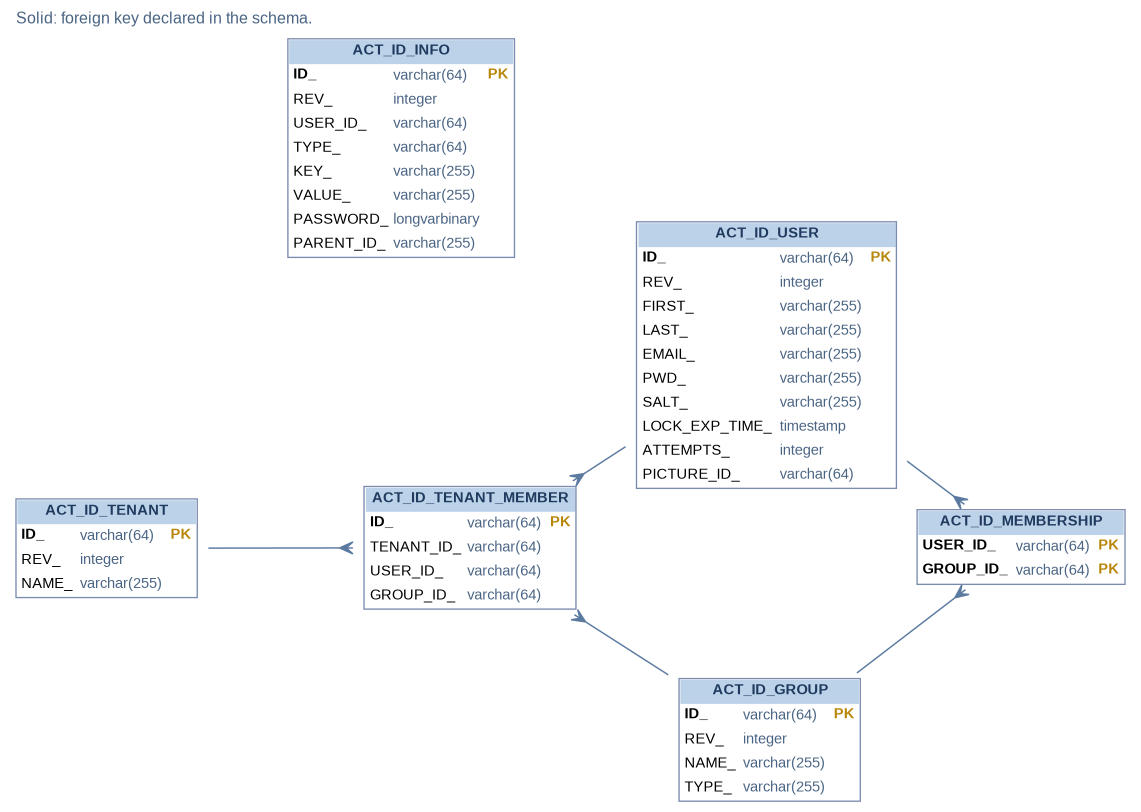
The following Entity Relationship Diagrams visualize the database tables and their explicit foreign key constraints, grouped by Engine with focus on BPMN, Engine with focus on DMN, the Engine History and the Identity. Please note that the diagrams do not visualize implicit connections between the tables.
These diagrams are generated from the engine’s own schema definition rather than drawn by hand, so they describe the tables and foreign keys a release actually creates.
Engine BPMN
Engine DMN
History
To allow different configurations and to keep the tables more flexible, the history tables contain no foreign key constraints. The relationships shown there are the ones the column names imply — PROC_INST_ID_, TASK_ID_ and the like — drawn as dashed lines to make clear that the database does not enforce them.
Identity
Replaced ad-hoc turn usage reports
ACT_HI_ADHOC_USAGE stores one immutable model-usage report per worker attempt of
a REPLACED turn. ID_ is its idempotency key and TURN_ID_ references
ACT_HI_ADHOC_TURN by convention; there are no foreign keys in history. Reports
also carry PROC_INST_ID_, ROOT_PROC_INST_ID_ and REMOVAL_TIME_ with indexes
for history deletion and retention updates. The engine deletes reports explicitly
after their parent turns; bounded retention cleanup only removes eligible reports
whose turn is gone. Reporting locks the parent and copies its current retention
metadata. When a turn has more reports than one cleanup batch can remove,
subsequent batches drain the remainder. A late report cannot recreate usage
after its parent turn has been removed. Model calls and nullable input/output token counts are summed into the
parent turn. The table is included in fresh history schemas and the released
1.4.2-to-1.4.3 upgrade for every supported database.